Some Himalayan treks impress you with a summit. Others win you over with a lake, a temple, or a dramatic mountain pass.
The Ali Bedni Bugyal Trek does something different.
It gives you space.
Space to walk, space to look around, and space to finally realise how small you are compared with the Himalayas.
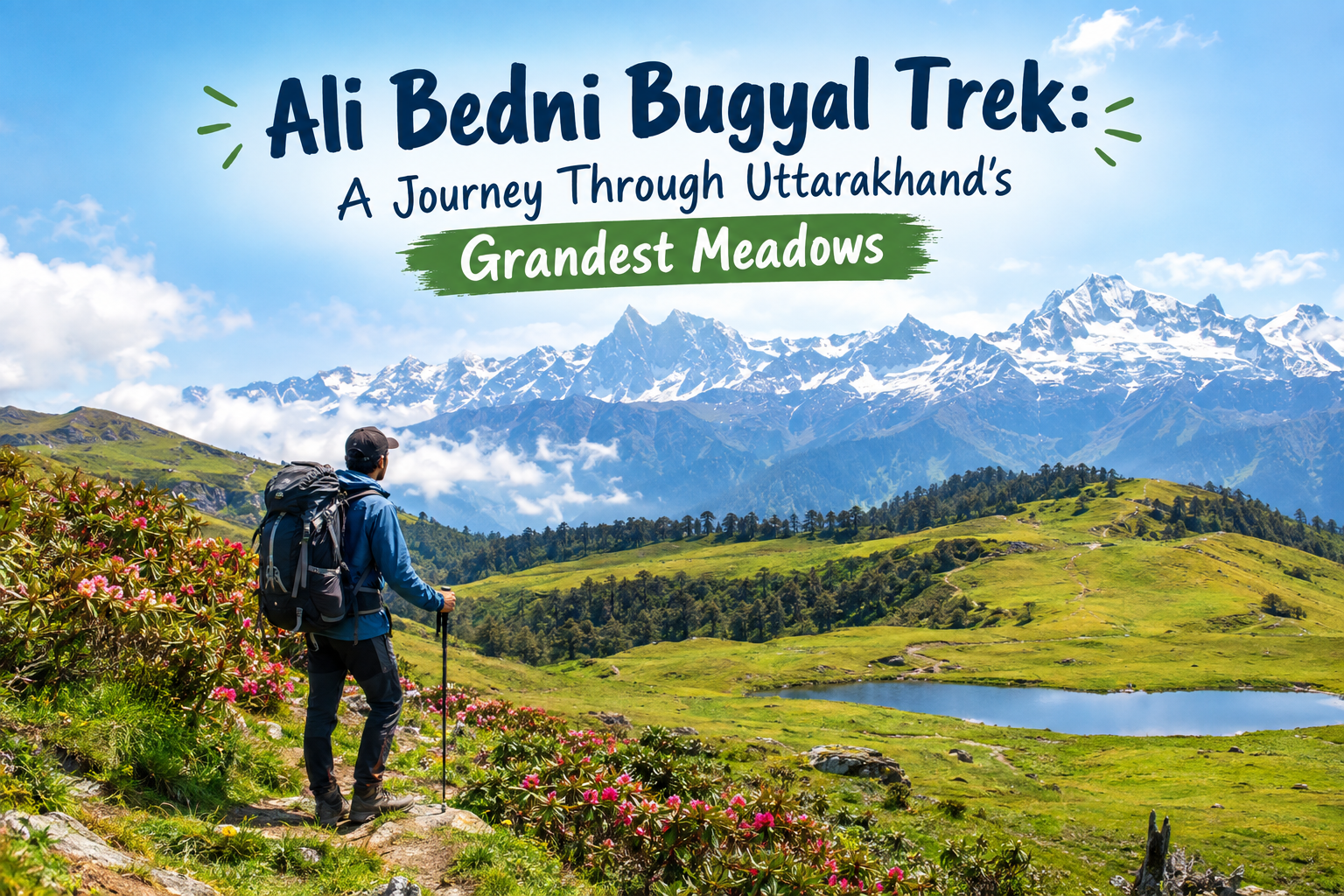
Ali Bugyal and Bedni Bugyal are two high-altitude alpine meadows in Uttarakhand. The trail passes through forests, open grasslands and high mountain terrain, with views of peaks such as Trishul and Nanda Ghunti.
And unlike many popular tourist places in Uttarakhand, you cannot simply drive up and take a photograph.
You have to walk for it.
That is a big part of the experience.
What Makes the Ali Bedni Bugyal Trek Special?
The biggest attraction of the trek is right in its name: Ali Bugyal and Bedni Bugyal.
A bugyal is a high-altitude meadow or alpine pasture. These open landscapes appear above the tree line and create a sharp contrast with the forests below.
Uttarakhand Tourism lists Ali Bugyal at around 3,354 metres, while Bedni Kund is around 3,561 metres. The official tourism itinerary describes the trek as a moderate trekking experience.
But numbers alone don’t explain why these meadows are so memorable.
Imagine walking through a forest for hours and then suddenly stepping into a huge open landscape.
The trees fall away.
The sky gets wider.
And mountains appear across the horizon.
That’s the moment Ali Bedni Bugyal starts to make sense.
Where Is Ali Bedni Bugyal?
Ali Bedni Bugyal lies in the Garhwal Himalayas of Uttarakhand.
The usual trekking approach begins around Lohajung, a mountain village that serves as a base for several treks in this region. The Uttarakhand Tourism Development Board lists Lohajung, Ghairoli Patal, Ali Bugyal and Bedni Bugyal among the main destinations on its official route.
Many modern trekking itineraries approach the trail through Wan, followed by Ghairoli Patal and the higher meadows.
The route can vary depending on the itinerary and trekking operator, so travellers should check the actual route before booking.
That small detail matters.
A trek’s name may stay the same while its daily distances, campsites and approach route can differ.
Ali Bedni Bugyal Trek Route
A commonly followed six-day itinerary includes travel from Rishikesh to Lohajung, four days of trekking and the return journey.
One established itinerary from follows this route:
Rishikesh → Lohajung → Wan → Ghairoli Patal → Bedni Bugyal → Ali Bugyal → Tithak → Wan → Lohajung → Rishikesh.
The exact route isn’t identical across every operator, but the main experience remains the same: forests first, meadows later.
Day 1: Rishikesh to Lohajung
The journey begins with a long mountain drive.
We lists the Rishikesh to Lohajung drive at around 270 km, taking roughly 10–11 hours on its itinerary. Lohajung sits at about 7,550 feet and acts as the base for the trek.
This isn’t the glamorous part of the journey.
Your back may complain.
Your phone battery may suddenly become very important.
But the road gradually takes you deeper into the Garhwal Himalayas, and reaching Lohajung puts you much closer to the real adventure.
Day 2: Wan to Ghairoli Patal
The trekking section begins around Wan on this itinerary.
The trail first moves through village surroundings before entering forested terrain.
One of the highlights is the Neel Ganga stream, followed by a continuous climb through oak and rhododendron forests towards Ghairoli Patal. We lists this section at about 6.3 km, with the trail climbing from around 7,550 feet to 10,350 feet.
This is an important part of the trek because you gain a considerable amount of altitude in a relatively short distance.
So don’t look at the kilometres and think, “Only six kilometres? Easy.”
Mountain kilometres have a different personality.
The forest also gives you your first real taste of the landscape that makes this trek special.
Day 3: Ghairoli Patal to Bedni Top
This is where the scenery changes dramatically.
The trail climbs through the forest and eventually reaches the tree line.
Then comes Bedni Bugyal.
After walking beneath trees, suddenly you have an open meadow in front of you.
It is one of the defining moments of the Ali Bedni Bugyal Trek.
The Trek itinerary places the highest point at around 12,550 feet at Bedni Top. From the higher sections, trekkers can see Mt Trishul and Nanda Ghunti prominently, subject to weather conditions.
The climb isn’t something you should underestimate.
You gain altitude, and some sections become steep.
But the reward is not another narrow summit.
It is a huge open landscape.
Day 4: Walking Across Ali Bugyal
If Bedni Bugyal gives you the big reveal, Ali Bugyal gives you time to enjoy it.
The trail crosses broad meadow terrain with long views in several directions.
We describes the section towards Ali Bugyal as a gradual meadow walk along the ridge, with views of peaks including Trishul, Nanda Ghunti and others when conditions are clear.
This is probably the closest the trek gets to a “slow travel” experience.
There is no need to rush.
You walk.
You stop.
You take photographs.
Then you walk another few minutes and stop again because the view somehow looks different.
The landscape is so open that even a small change in weather can completely change the scene.
The Views of Trishul and Nanda Ghunti
Mountain views are one of the biggest reasons people choose the Ali Bedni Bugyal Trek.
The meadows offer views towards major Himalayan peaks, particularly Mt Trishul and Mt Nanda Ghunti. Trekking Company also notes views of other major peaks and the Chaukhamba massif from sections of the trail.
But there is an important point for responsible travel writing:
Don’t promise that every trekker will get perfect mountain views.
The Himalayas don’t work like that.
Clouds can cover peaks.
Rain can arrive unexpectedly.
Fog can completely change the landscape.
A clear day can give you an enormous mountain panorama, while a cloudy day can leave the peaks hidden.
And honestly, that’s part of trekking.
You go for the landscape, not a guaranteed photograph.
Bedni Kund and Its Cultural Importance
Bedni Kund is another important feature around Bedni Bugyal.
The Uttarakhand Tourism Development Board includes Bedni Kund in its official route information and places it at around 3,561 metres.
The area is not simply a scenic location.
High Himalayan landscapes often have cultural and religious importance for local communities, so visitors should treat the area with respect.
That means avoiding litter, staying on appropriate trails and not damaging vegetation.
A beautiful meadow can recover from footsteps.
A plastic bottle is a much more stubborn guest.
How Difficult Is the Ali Bedni Bugyal Trek?
The Ali Bedni Bugyal Trek is generally considered suitable for fit beginners, but it isn’t a casual walk.
The Uttarakhand Tourism Development Board classifies its official itinerary as moderate trekking.
Trekking Company currently describes its route as easy-moderate for fit beginners, while highlighting steep ascents, descents and significant altitude gain. Its itinerary covers roughly 27 km over four trekking days and reaches about 12,550 feet.
The first major challenge comes from the climb towards Ghairoli Patal.
Another demanding section comes while climbing towards Bedni Bugyal and Bedni Top.
And then there are the descents.
Trekkers often focus on climbing strength, but downhill walking can also put considerable stress on the knees.
So preparation should include both cardiovascular fitness and leg strength.
Best Time for Ali Bedni Bugyal Trek
There isn’t one perfect season for everyone.
The best time depends on what you want to see.
Spring: March to April
Spring brings the forest back to life after winter.
Rhododendrons can bloom along the forest sections, and snow may still remain around higher areas.
Trekking Company identifies spring as a good period for clear mountain views and rhododendron blooms.
Summer: May to June
Summer brings greener meadows.
By June, the landscape can become particularly green, with wildflowers appearing in the higher meadows.
This is a good choice if your main goal is to experience Ali and Bedni as lush Himalayan grasslands.
Post-Monsoon: September to November
After the monsoon season, the skies can become clearer and mountain visibility can improve.
We recommends the post-monsoon period for trekkers who particularly want mountain views and photography.
The landscape also develops a different colour compared with the greener summer months.
Winter: December to March
Winter changes everything.
Snow can cover the higher sections and forests, creating a completely different experience.
We notes that snowfall is a distinct possibility around Bedni Top during winter.
But winter trekking needs proper clothing, suitable footwear and careful attention to weather and trail conditions.
Snow looks beautiful.
It also makes walking more complicated.
Both statements can be true.
What Should You Pack?
Your packing list should match the season and the conditions expected during your trek.
Basic essentials include:
- Good trekking shoes with proper grip
- Warm layers
- Waterproof rain protection
- Gloves and a warm cap in cold weather
- Water bottles
- Personal medicines
- Sunscreen and sunglasses
- Headlamp
- Basic toiletries
- A small backpack for daily essentials
During winter, you need additional protection against cold and snow.
Don’t rely on buying everything at the last village.
Some local shops may carry basic trekking items, but it is better to arrive prepared. Guides specifically advises trekkers not to depend on local shops for all required equipment.
Why You Should Not Rush This Trek
The biggest mistake on a meadow trek is treating the destination like a checklist.
Ali Bugyal.
Bedni Bugyal.
Bedni Top.
Photograph.
Done.
That approach misses the whole point.
The beauty of this route comes from the transition.
You begin among villages and forests.
You cross streams.
You climb through oak and rhododendron.
The trees eventually thin out.
Then the meadow opens.
And suddenly the mountains dominate the horizon.
That gradual change is what makes the journey memorable.
Responsible Trekking at Ali Bedni Bugyal
The popularity of Himalayan trekking brings responsibility.
Stay on established trails where possible.
Carry your waste back.
Avoid disturbing wildlife.
Do not damage alpine vegetation.
Respect local customs and communities.
And don’t assume that because a place looks empty, it has no environmental limits.
Alpine meadows are fragile ecosystems.
The reason Ali and Bedni Bugyal look so spectacular is precisely because they have remained largely open and natural.
Visitors have a role in keeping them that way.
Is the Ali Bedni Bugyal Trek Worth It?
Yes, if you want a Himalayan trek where the journey and landscape matter as much as reaching a final point.
The trek combines forests, streams, alpine meadows, high-altitude terrain and major Himalayan views in one route.
It also offers something that many travellers increasingly want: a break from crowded tourist centres.
You don’t need a long list of activities here.
The mountains provide the entertainment.
And they are surprisingly good at it.
The Ali Bedni Bugyal Trek is not the easiest walk in Uttarakhand, and it isn’t completely untouched or unknown. But it offers a rare combination of open meadows and dramatic mountain scenery that makes the effort worthwhile.
If you prepare properly, choose the right season and respect the landscape, Ali Bedni can become much more than another name on your trekking list.
It can become one of those Himalayan journeys you remember long after your shoes have finally recovered.
Ali Bedni Bugyal Trek: Quick Facts
| Detail | Information |
|---|---|
| Location | Garhwal Himalayas, Uttarakhand |
| Main base | Lohajung |
| Major meadows | Ali Bugyal and Bedni Bugyal |
| Important landmark | Bedni Kund |
| Highest point on common itinerary | Around 12,550 ft at Bedni Top |
| Trek difficulty | Moderate / Easy-Moderate for fit beginners, depending on route |
| Trekking duration | Around 4 trekking days in a common 6-day itinerary |
| Main terrain | Forests, streams, alpine meadows and mountain trails |
| Popular seasons | Spring, summer, post-monsoon and winter, depending on conditions |
| Major mountain views | Trishul, Nanda Ghunti and other Himalayan peaks |
Final Word
The Ali Bedni Bugyal Trek doesn’t need exaggerated claims. Its real strengths are already enough.
Two huge alpine meadows. Dense Himalayan forests, A changing trail, High mountain views,
And the simple pleasure of walking through a landscape that feels much bigger than everyday life.
That’s what makes Ali Bedni Bugyal worth experiencing.
You don’t just reach the meadows.